

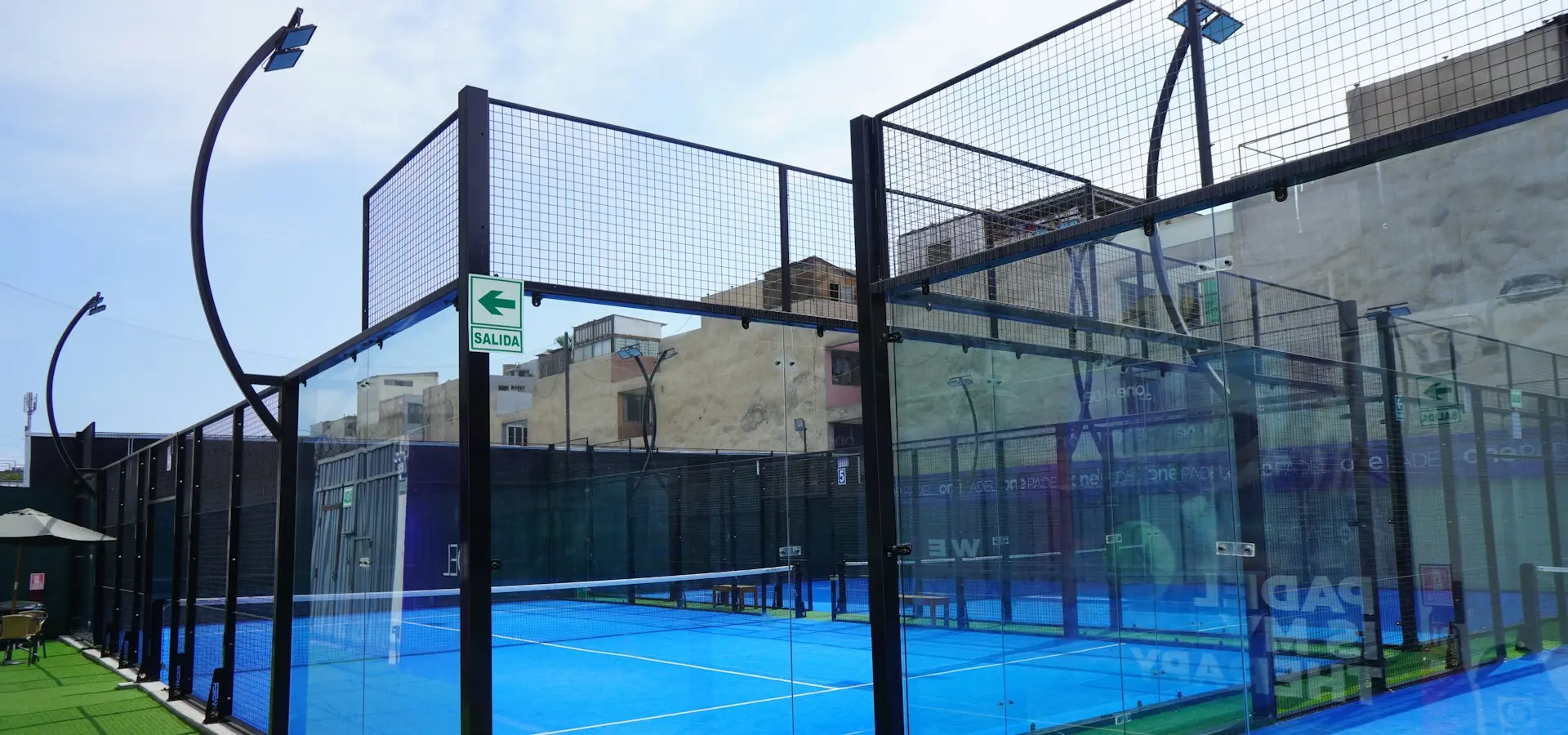
Quick answer: padel is played in doubles on an enclosed court. You serve underhand after bouncing the ball, diagonally into the opponents’ service box. The ball must bounce once on the opponents’ side before touching any wall, and after that bounce it can be played off the walls. Scoring is the same as tennis.
The court
- 20 m long and 10 m wide (about 66 × 33 ft), divided by a net.
- Enclosed by glass walls at the back and partly on the sides, with metal mesh fencing elsewhere.
- Each half has two service boxes, like tennis, marked on artificial turf.
How to serve
- Stand behind the service line and bounce the ball once on the ground.
- Hit it underhand, with the ball at or below waist height at contact.
- Serve diagonally into the opponents’ service box.
- After bouncing in the box, the serve can hit the glass and is still good. If it hits the metal fence after the bounce, it is a fault.
- You get two serves, like in tennis. If the ball touches the net and lands in the box, it is a let and you repeat it.
The key rule: walls
- On your side: after the ball bounces, you can let it hit your walls and then return it.
- Returning the ball: your shot must cross the net and land in the opponents’ court. It cannot hit their walls or fence before bouncing.
- Using your own walls: you can hit the ball against your own walls so that it goes over the net, as long as it then bounces in the opponents’ court.
- Volleys: you can volley any ball except the return of serve, which must bounce first.
Scoring
Padel uses tennis scoring: 15, 30, 40 and game. Six games win a set (with a two-game lead or a tiebreak at 6–6), and matches are usually best of three sets. Many leagues and the pro tours use the golden point: at 40–40 the next point wins the game, and the receiving pair chooses who returns.
You lose the point if…
- The ball bounces twice on your side.
- Your shot hits the opponents’ wall or fence before bouncing in their court.
- The ball hits you or your partner.
- You touch the net with your body or racket.
Etiquette from Spanish courts
- Call your own balls honestly.
- Do not hit the ball hard at opponents at the net from close range.
- Change sides on odd games.
- Bring new balls: in Spain it is common for players to take turns opening a new can.
Ready to play? Start with the best padel rackets for beginners and compare it with pickleball in padel vs pickleball.
FAQ
Can you hit the wall in padel?
Yes, after the ball bounces on your side you can let it come off your walls and return it. Your shot must then land in the opponents’ court before touching their walls.
Is the padel serve underhand?
Yes. You bounce the ball and hit it underhand, with contact at or below waist height, diagonally into the opponents’ service box.
How is padel scored?
Like tennis: 15, 30, 40 and game, six games to win a set. Many competitions use the golden point at 40–40.
Can you volley the serve in padel?
No. The return of serve must bounce first. After that, any ball can be volleyed.
[…] Keep reading: Best padel rackets for beginners · Padel vs pickleball · Padel rules explained […]